

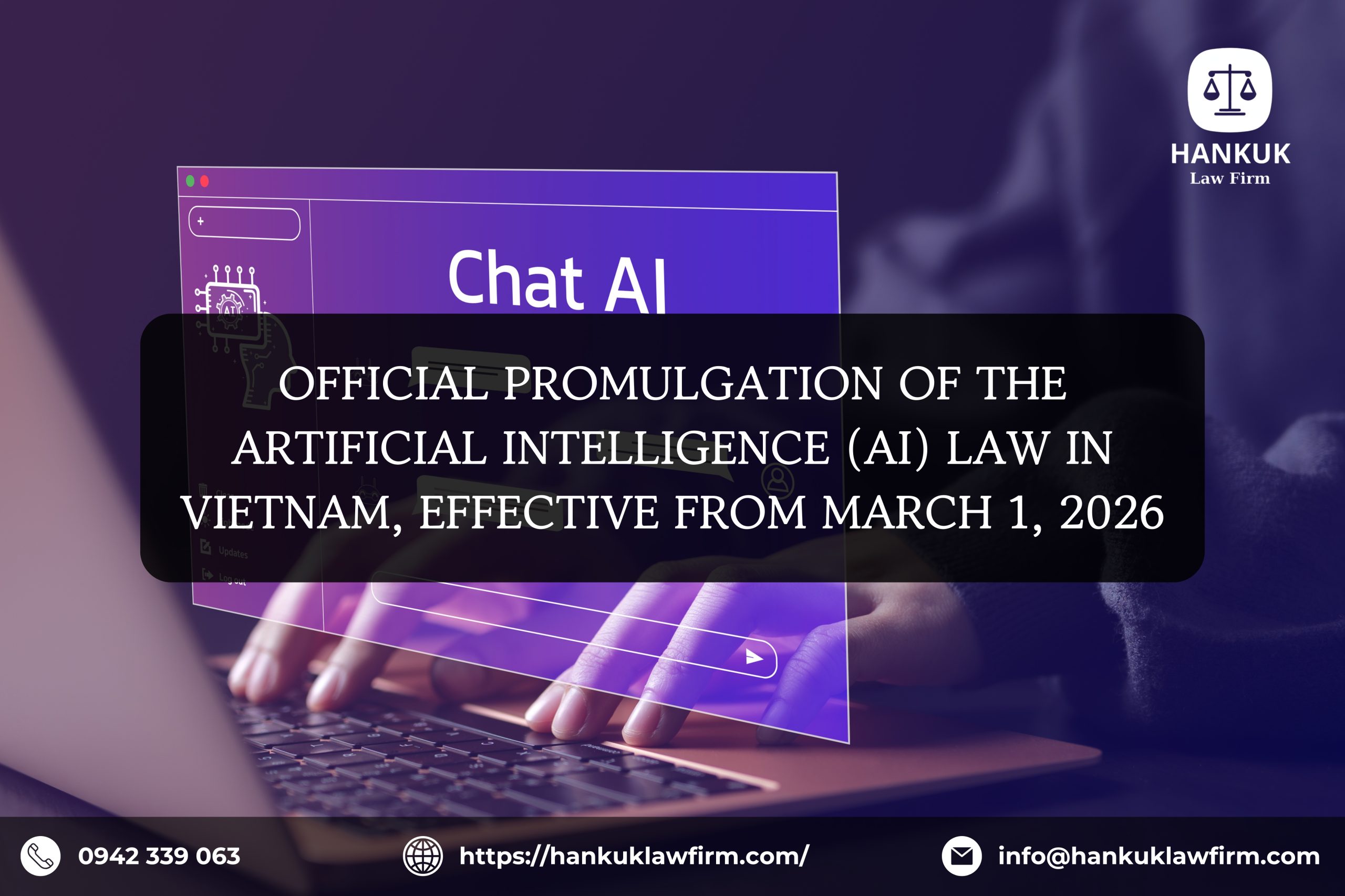
OFFICIAL PROMULGATION OF THE ARTIFICIAL INTELLIGENCE (AI) LAW IN VIETNAM, EFFECTIVE FROM MARCH 1, 2026
I. Legal basis
- Law on Artificial Intelligence 2025
The Law on Artificial Intelligence 2025 comprehensively governs the entire lifecycle of AI, from design, training, and testing to market deployment and use in professional, commercial, and service activities. The Law sets out the rights, obligations, and liabilities of relevant organizations and individuals, as well as the State’s regulatory framework for AI. Notably, AI activities serving national defense, security, and cryptography purposes fall outside the scope of this Law. The Law applies to Vietnamese agencies, organizations, and individuals, as well as foreign organizations and individuals implementing AI systems in Vietnam. The Law shall take effect from March 1, 2026.
II. A uniform legal definition of Artificial Intelligence (AI)
Pursuant to Article 3 of the Law on Artificial Intelligence 2025, “artificial intelligence” means the electronic simulation or execution of human intellectual capabilities, including learning, reasoning, perception, judgment, and the understanding of natural language.
An “artificial intelligence system” means a machine-based system designed to perform AI capabilities with varying degrees of autonomy, and which may exhibit adaptive behavior after deployment, generating outputs such as predictions, content, recommendations, or decisions that may influence physical or virtual environments.
A “developer” means any organization or individual that designs, builds, trains, tests, or fine-tunes an AI model or system, and exercises direct control over the technical methods, training data, or model parameters.
A “provider” means any entity that places an AI system on the market or puts it into service under its own name or trademark, regardless of whether it has directly developed such a system.
A “deployer” means any organization, individual, or state authority that uses an AI system in professional, commercial, or service activities, excluding use for personal, non-commercial purposes.
A “user” means any organization or individual that directly interacts with or uses the outputs of an AI system, while an “affected person” means any individual whose lawful rights and interests, life, health, property, reputation, or access to services may be directly or indirectly impacted by the deployment of, or the outputs generated by, an AI system.
III. Principles governing Artificial Intelligence (AI) operations
Pursuant to Article 4 of the Law on Artificial Intelligence 2025, four core principles are established to guide the entire development and application of AI in Vietnam.
- First, AI must be human-centric, ensuring the protection of human rights, privacy, national security, and compliance with applicable laws. This affirms that AI must not operate outside the legal framework or cause harm to fundamental values.
- Second, AI shall not replace human authority and accountability. Human operators must retain control and the ability to intervene in all decisions generated by AI systems, while ensuring system safety and data security.
- Third, AI must ensure fairness, transparency, and the absence of bias. Organizations and individuals using AI are responsible for identifying and preventing inaccuracies and discriminatory outcomes, and must be able to provide accountability and explainability for decisions generated by AI systems.
- Finally, the Law encourages the development of AI in a green and sustainable manner, promoting energy efficiency and minimizing adverse environmental impacts.
IV. Prohibited acts in Artificial Intelligence activities
Pursuant to Article 7 of the Law on Artificial Intelligence, a stringent list of prohibited acts is established to safeguard security, human rights, and the public interest. The Law prohibits any act of exploiting or misappropriating AI systems to infringe upon the lawful rights and interests of organizations and individuals. In particular, it strictly prohibits the development or use of AI for the purposes of deception, manipulation of perception, or causing serious harm to individuals and society. This includes the creation of falsified content, such as deepfakes, for fraudulent purposes or to incite public confusion. The Law also prohibits the exploitation of vulnerabilities of vulnerable groups, including children, the elderly, and persons with disabilities. Furthermore, the unlawful collection and use of data for the training or operation of AI systems, in violation of laws on personal data protection, intellectual property, and cybersecurity, are strictly prohibited. Acts that obstruct human oversight mechanisms, conceal information subject to mandatory transparency requirements, or misuse research and testing activities to commit violations are likewise included in the list of prohibited acts.
V. What should businesses prepare when the AI law takes effect?
- For technology companies and startups: it is necessary to review AI solutions against the risk classification framework (to determine whether they fall within categories subject to stringent controls), prepare to comply with requirements on transparency, impact assessment, and human oversight, and concurrently leverage available support mechanisms (including vouchers, regulatory sandboxes, and funding schemes) when conducting pilot deployments.
- For organizations deploying AI in public services, healthcare, finance, and security: particular attention must be paid to requirements on human oversight and decision transparency where AI systems significantly affect the rights, interests, or safety of individuals.
For individuals: the Law emphasizes user rights, including requirements on data protection, transparency, and accountability in cases where AI causes harm. These safeguards will be further specified in implementing regulations and accompanying decrees.
VI. About Us, Hankuk Law Firm
■ Hankuk Law Firm – Introduction
The goal of the legal services provided by HANKUK LAW FIRM is to support businesses, investors, and people. Our organization employs skilled Korean lawyers, partners, and professionals to provide legal services to businesses related to corporations and litigation.
To support the startup process, our lawyers and staff provide a wide range of services, including business law consulting, tax and immigration law consulting, real estate services, business consulting, marketing and communications, human resources, product distribution, franchise options, etc. We provide expert advice on every aspect of your business needs.
To protect the legitimate rights and interests of our clients and achieve the best results, we provide legal advice and participate in civil lawsuits related to business, labor, marriage, family, and inheritance.
■ Contact us now

For reliable and effective legal advice, please contact HANKUK LAW FIRM now. We are committed to providing you with the best possible answers and our team of experienced lawyers has extensive knowledge in many legal fields. We are always here to provide the most competent and dedicated support, whether you are dealing with contractual issues, commercial disputes or need guidance on foreign investment. HANKUK LAW FIRM is honored to have assisted hundreds of domestic and international clients in skillfully resolving complex legal issues as their trusted legal partner. Do not let legal issues hinder your success. Let us accompany you towards legal achievement and comfort. For prompt guidance and support to ensure your rights are always maintained at the highest standards, contact HANKUK LAW FIRM now.
■ Contact Hankuk Law Firm:
| Website: http://hankuklawfirm.com/en/
FB: https://www.facebook.com/hankuk.lawfirm Tiktok: https://www.tiktok.com/@hankuklawfirm Youtube: https://www.youtube.com/@hankuklawfirm6375 Email: info@hankuklawfirm.com SĐT: 0942.339.063 |
 |