

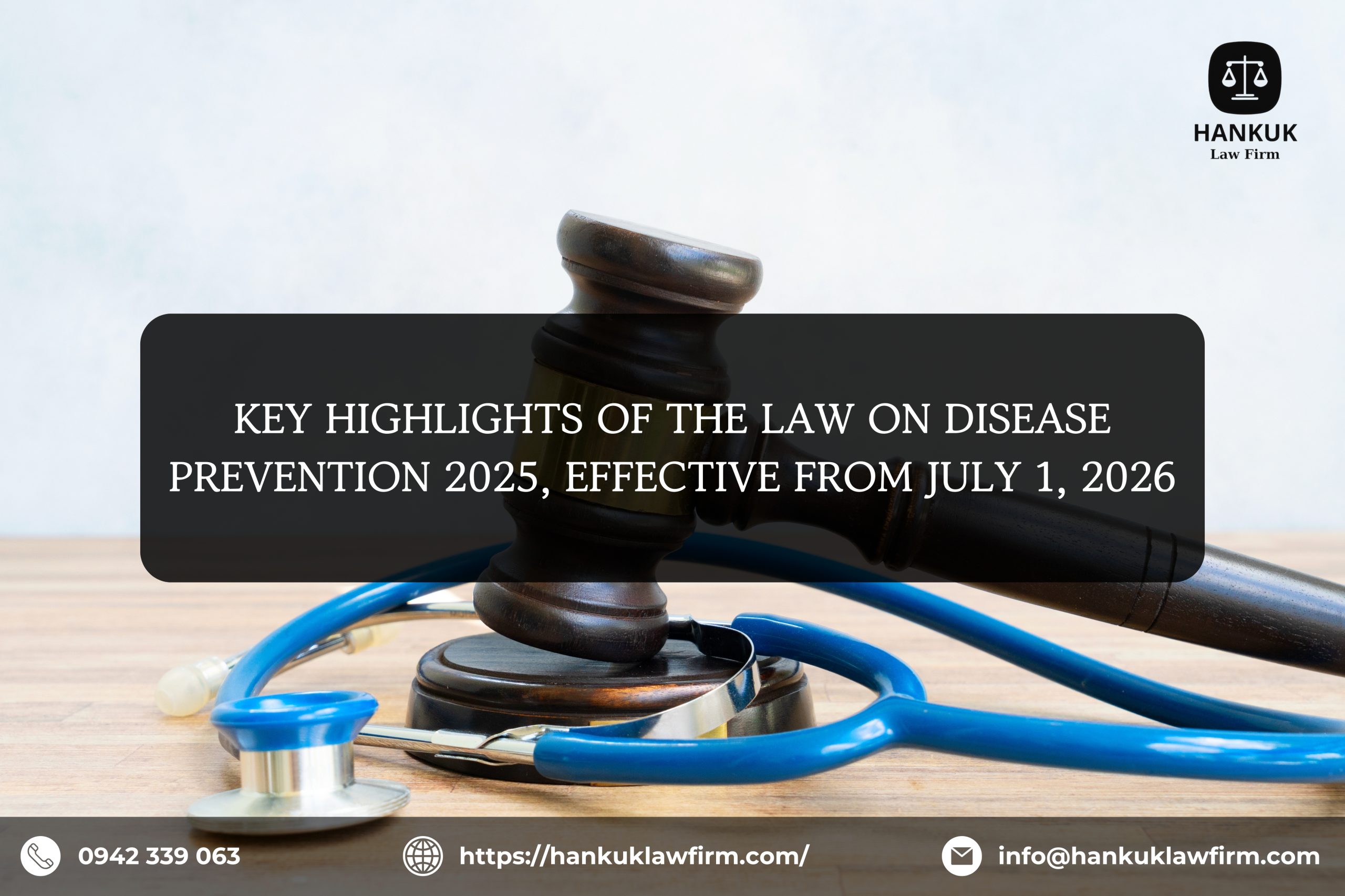
KEY HIGHLIGHTS OF THE LAW ON DISEASE PREVENTION 2025, EFFECTIVE FROM JULY 1, 2026
I. Legal basis
- Law on Disease Prevention 2025
The Law on Disease Prevention No. 114/2025/QH15 was adopted by the 15th National Assembly of the Socialist Republic of Viet Nam at its 10th Session on December 10, 2025. The Law officially takes effect on July 1, 2026, and replaces in its entirety the Law on Prevention and Control of Infectious Diseases No. 03/2007/QH12 (as amended and supplemented).
II. Key highlights of the Law on Disease Prevention 2025
The Law on Disease Prevention 2025 not only inherits appropriate provisions of the previous law but also introduces numerous new and breakthrough provisions aimed at enhancing preventive capacity, strengthening epidemic control, and ensuring a comprehensive healthcare response. Below are the four most notable highlights:
1. Strengthening the capacity of the epidemiological surveillance system
Pursuant to Article 13 of the Law on Disease Prevention 2025, a mechanism is introduced for the establishment of a multi-tiered disease surveillance system, ensuring close linkage from the commune and ward levels to the central level. This system makes extensive use of information technology, digital data, big data, and artificial intelligence-based analytical tools to enable early detection and timely warning of epidemiological risks, as well as risk factors related to infectious and non-communicable diseases, mental health disorders, nutrition, and injuries.
This provision facilitates the prompt and scientific implementation of intervention measures, thereby minimizing the risk of disease outbreaks. It represents a significant advancement compared to the previous law, as surveillance is now digitized and fully integrated nationwide, contributing to improved disease prevention effectiveness at the grassroots level.
2. Renewing the disease prevention strategy towards early and remote prevention
Pursuant to Article 4 of the Law on Disease Prevention 2025, the Law emphasizes proactive disease prevention as the primary approach, with the people identified as the central actors. The implemented measures include:
- Expanded immunization (both mandatory and voluntary vaccination programs);
- Community nutrition interventions (with priority given to the first 1,000 days of life and support for vulnerable groups);
- Prevention and control of non-communicable diseases (including cancer, cardiovascular diseases, diabetes, etc.);
- Prevention and management of mental health disorders;
- Health communication and health education activities.
Pursuant to Article 27 of the Law on Disease Prevention 2025, disease prevention programs are organized on a long-term basis, with clearly defined impact assessments, and are closely aligned with sustainable development objectives and life-course health care. The population is entitled to periodic health check-ups or free screening services at least once per year, based on population groups and prioritized implementation schedules. For the first time, many of these provisions are explicitly stipulated in law, thereby facilitating a shift in focus from treatment to early and remote prevention.
3. Improving and finalizing financial policies for disease prevention activities
Article 43 of the Law on Disease Prevention 2025 establishes the legal framework for the disease prevention fund, the mechanism for mobilizing social resources, and the allocation of budgetary resources with priority given to preventive activities. The fund is formed from:
- Charter capital contributed from the State budget;
- 2% of the special consumption tax on tobacco products;
- Transitional funding from the Fund for Prevention and Control of Tobacco Harms;
- Sponsorships, contributions, and other lawful sources.
The Fund is used to support the prevention and control of non-communicable diseases, mental health disorders, nutrition-related issues, periodic health examinations, scientific and technological research, and large-scale preventive activities. The State budget ensures recurrent expenditures and development investment for preventive healthcare; investment in disease prevention is regarded as a “return-generating investment,” contributing to reduced treatment costs and alleviating the burden on the healthcare system. This constitutes a sustainable and flexible financial mechanism that effectively mobilizes socialized resources.
The Law on Disease Prevention 2025 clearly stipulates the specific responsibilities of People’s Committees at all levels and healthcare facilities:
- Pursuant to Article 5 of this Law, local authorities are required to develop annual disease prevention plans with specific targets, allocated resources, and clearly defined implementation responsibilities.
- Preventive healthcare institutions and medical examination and treatment facilities must ensure adequate capacity to respond to public health emergencies, carry out health communication activities, participate in epidemiological surveillance, and implement disease prevention measures in accordance with the guidance of the Ministry of Health.
The Law also provides for regimes and preferential policies applicable to personnel engaged in disease prevention, including state-funded postgraduate training in preventive medicine. It further encourages the socialization of preventive healthcare services and prioritizes implementation in remote, mountainous, border, and island areas. Responsibilities are clearly defined and linked to performance evaluation, thereby creating strong implementation incentives from the central to the grassroots levels.
III. Conclusion
The Law on Disease Prevention 2025 marks a significant shift in the development orientation of Viet Nam’s healthcare system, from a treatment-focused approach to strengthening disease prevention and proactive health care. Effective from July 1, 2026, the Law aims to improve public health outcomes through activities such as periodic health examinations, vaccination, nutrition, and mental health support, while also contributing to the consolidation of a stable and sustainable healthcare system.
For the effective implementation of the Law’s provisions, coordinated efforts among competent authorities, relevant organizations, and the participation of the public are required. This serves as an important foundation for the gradual enhancement of healthcare quality and the capacity to respond to emerging health challenges in the new phase.
IV. About Us, Hankuk Law Firm
■ Hankuk Law Firm – Introduction
The goal of the legal services provided by HANKUK LAW FIRM is to support businesses, investors, and people. Our organization employs skilled Korean lawyers, partners, and professionals to provide legal services to businesses related to corporations and litigation.
To support the startup process, our lawyers and staff provide a wide range of services, including business law consulting, tax and immigration law consulting, real estate services, business consulting, marketing and communications, human resources, product distribution, franchise options, etc. We provide expert advice on every aspect of your business needs.
To protect the legitimate rights and interests of our clients and achieve the best results, we provide legal advice and participate in civil lawsuits related to business, labor, marriage, family, and inheritance.
■ Contact us now

For reliable and effective legal advice, please contact HANKUK LAW FIRM now. We are committed to providing you with the best possible answers and our team of experienced lawyers has extensive knowledge in many legal fields. We are always here to provide the most competent and dedicated support, whether you are dealing with contractual issues, commercial disputes or need guidance on foreign investment. HANKUK LAW FIRM is honored to have assisted hundreds of domestic and international clients in skillfully resolving complex legal issues as their trusted legal partner. Do not let legal issues hinder your success. Let us accompany you towards legal achievement and comfort. For prompt guidance and support to ensure your rights are always maintained at the highest standards, contact HANKUK LAW FIRM now.
■ Contact Hankuk Law Firm:
| Website: http://hankuklawfirm.com/en/
FB: https://www.facebook.com/hankuk.lawfirm Tiktok: https://www.tiktok.com/@hankuklawfirm Youtube: https://www.youtube.com/@hankuklawfirm6375 Email: info@hankuklawfirm.com SĐT: 0942.339.063 |
 |