

WHEN IS MEDIATION NOT REQUIRED IN DIVORCE PROCEEDINGS?
I. Legal basis
- Law on Marriage and Family 2014
- Civil Procedure Code 2015
II. What is divorce mediation?
Divorce mediation is a process in which a neutral third party (typically a respected community figure or a Judge) assists and encourages the parties involved in a divorce dispute to reach a voluntary settlement. Its primary objectives are to facilitate reconciliation where possible, resolve disagreements amicably, and safeguard the lawful rights and interests of both spouses and their children.
Forms of Divorce Mediation: Divorce mediation may be conducted at the grassroots level (such as residential groups, villages, hamlets, or local communities), before the Court, or through a commercial arbitration center.
III. Is mediation mandatory when spouses divorce?
Pursuant to Article 52 of the 2014 Law on Marriage and Family, the State encourages mediation at the grassroots level in relation to marriage and family matters, as follows:
- The State and society encourage grassroots-level mediation where a husband and wife seek a divorce. Such mediation shall be conducted in accordance with the laws governing grassroots mediation.
Accordingly, as a general principle, the State encourages spouses who intend to divorce to first pursue grassroots-level mediation as a means of resolving their marital disputes and conflicts.
However, where the spouses have decided to file a divorce petition with the Court, they are required to undergo a mandatory mediation process in accordance with Article 54 of the 2014 Law on Marriage and Family. This requirement forms an integral part of the legal proceedings and is intended to ensure that all reasonable efforts toward reconciliation and amicable settlement have been exhausted before the Court renders a formal decision on the divorce.
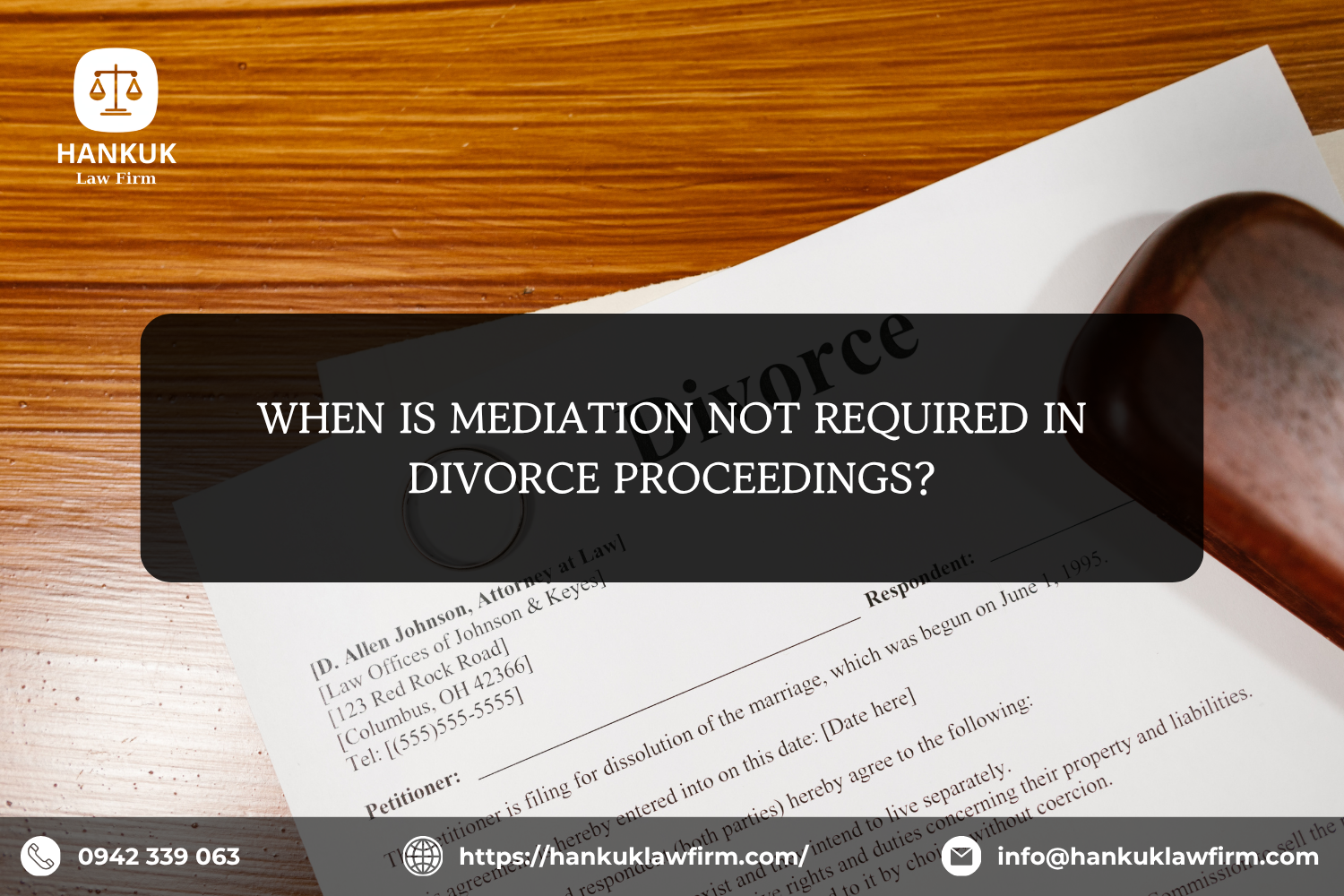
IV. Cases where mediation is not conducted in divorce proceedings
Pursuant to Article 207 of the 2015 Civil Procedure Code, the following civil cases are not eligible for mediation proceedings:
- First, where the respondent in the divorce proceedings or a person with related rights and obligations intentionally fails to appear despite having been duly summoned by the Court for the second time.
- Second, where the spouses are unable to participate in mediation due to legitimate reasons.
- Third, where either spouse involved in the divorce case has been declared a person lacking civil act capacity.
- Fourth, where either spouse requests that mediation not be conducted.
In such cases, as prescribed by law, the parties may proactively submit a written request to the Court, asking that the mediation procedure not be conducted and that the divorce matter be resolved through an expedited judicial process instead.
V. Principles of mediation in divorce proceedings
- Respect the spouses’ voluntary agreement in divorce proceedings; no force or threat of force may be used, nor may the parties be compelled to reach any agreement that is contrary to their free will and genuine intentions.
- The contents of any agreement reached between the spouses in connection with the divorce must not violate any prohibitory provisions of law or contravene social ethics.
VI. Divorce mediation procedures
Step 1: Explanation of rights and obligations: The Judge shall explain to the parties (the husband and wife) their respective rights and obligations.
Step 2: Presentation of the matters in dispute: The parties shall present the matters in dispute, supplement their claims or requests, provide grounds and evidence in support of their respective claims or requests, and propose solutions for the resolution of the case.
Step 3: Identification of issues: The Judge shall identify and determine the matters on which the parties have reached agreement and those on which they have not, request any necessary supplementation, and clarify any issues that remain unclear.
Step 4: Preparation of minutes and issuance of a decision
- The Court shall prepare minutes recording the outcome of the divorce mediation. Depending on the outcome of the mediation, the Court shall issue the appropriate decision(s) in accordance with the law.
- Recognition of the parties’ agreement on divorce.
- Suspension or termination of the proceedings.
- Referral of the case for trial (where mediation is unsuccessful).
VII. About Us, Hankuk Law Firm
■ Hankuk Law Firm – Introduction
The goal of the legal services provided by HANKUK LAW FIRM is to support businesses, investors, and people. Our organization employs skilled Korean lawyers, partners, and professionals to provide legal services to businesses related to corporations and litigation.
To support the startup process, our lawyers and staff provide a wide range of services, including business law consulting, tax and immigration law consulting, real estate services, business consulting, marketing and communications, human resources, product distribution, franchise options, etc. We provide expert advice on every aspect of your business needs.
To protect the legitimate rights and interests of our clients and achieve the best results, we provide legal advice and participate in civil lawsuits related to business, labor, marriage, family, and inheritance.
■ Contact us now

For reliable and effective legal advice, please contact HANKUK LAW FIRM now. We are committed to providing you with the best possible answers and our team of experienced lawyers has extensive knowledge in many legal fields. We are always here to provide the most competent and dedicated support, whether you are dealing with contractual issues, commercial disputes or need guidance on foreign investment. HANKUK LAW FIRM is honored to have assisted hundreds of domestic and international clients in skillfully resolving complex legal issues as their trusted legal partner. Do not let legal issues hinder your success. Let us accompany you towards legal achievement and comfort. For prompt guidance and support to ensure your rights are always maintained at the highest standards, contact HANKUK LAW FIRM now.
■ Contact Hankuk Law Firm:
| Website: http://hankuklawfirm.com/en/
FB: https://www.facebook.com/hankuk.lawfirm Tiktok: https://www.tiktok.com/@hankuklawfirm Youtube: https://www.youtube.com/@hankuklawfirm6375 Email: info@hankuklawfirm.com SĐT: 0942.339.063 |
 |